<?xml version="1.0" encoding="utf-8"?><feed xmlns="http://www.w3.org/2005/Atom" ><generator uri="https://jekyllrb.com/" version="3.10.0">Jekyll</generator><link href="/feed.xml" rel="self" type="application/atom+xml" /><link href="/" rel="alternate" type="text/html" /><updated>2026-07-01T22:18:31+00:00</updated><id>/feed.xml</id><title type="html">Alex’s Tech Talk Blog</title><subtitle>I write about technology and politics.</subtitle><entry><title type="html">Autonomous vehicles will improve urbanism</title><link href="/2024/09/02/autonomous-vehicles-urbanism.html" rel="alternate" type="text/html" title="Autonomous vehicles will improve urbanism" /><published>2024-09-02T20:30:00+00:00</published><updated>2024-09-02T20:30:00+00:00</updated><id>/2024/09/02/autonomous-vehicles-urbanism</id><content type="html" xml:base="/2024/09/02/autonomous-vehicles-urbanism.html"><![CDATA[<!-- Research Links and Notes

Topics:
 - Would cost less than owning a car
 - Decrease total amount of cars on the roads
 - Decrease need for driveways and garages
 - Decrease need for destination parking
 - Increase demand for mass transit
 - Increase demand for walkable areas
 - Give people more freedom of movement
-->

<p>Autonomous Vehicles, or self-driving cars, are already making an impact. For example, Waymo is currently providing <a href="https://www.teslarati.com/waymo-100000-paid-rides-week/">100k paid rides a week</a> and plans to expand to more cities, while Tesla is expected to unveil its Robotaxi on <a href="https://www.automotivedive.com/news/telsa-robotaxi-unveil-oct-10-elon-musk/724137/">10/10</a> 2024. Other companies are also entering this market. It is very likely that by 2030 autonomous vehicles will be commonplace in every major metro area in the United States, if not in all metro areas. What will be the impact of autonomous vehicles on urbanism and daily life? I argue that urbanism will improve, along with everyone’s quality of life.</p>

<p>My argument can break down into these key points:</p>
<ul>
  <li>Riding in autonomous vehicles will cost less than owning a car.</li>
  <li>The total number of cars on the road will decrease.</li>
  <li>The demand and need for personal garages and driveways will decrease.</li>
  <li>The demand and need for parking lots will decrease.</li>
  <li>Demand for mass transit will increase.</li>
  <li>Demand for walkable areas will increase.</li>
  <li>All people will have increased freedom.</li>
</ul>

<h2 id="less-expensive-than-owning-a-car">Less expensive than owning a car</h2>

<p>Currently, relying on ride-hailing services for all your transportation needs is prohibitively expensive because fares cover not only the vehicle’s cost but also the labor and the fleet-operator’s profit. For most people, it’s more economical to own a car and drive it themselves, avoiding the additional expenses tied to labor and fleet profits. However, the introduction of autonomous vehicles is set to change this equation.</p>

<p>With fleet-operated autonomous vehicles serving as taxis the cost per mile to ride an autonomous vehicle would be less than the cost per mile of driving a car you own. That would be possible because many fixed costs would decrease due to higher utilization.</p>

<table>
  <thead>
    <tr>
      <th>Cost</th>
      <th>Robotaxis</th>
      <th>Owned Car</th>
    </tr>
  </thead>
  <tbody>
    <tr>
      <td>Electricity</td>
      <td>Not Shared</td>
      <td>Not Shared</td>
    </tr>
    <tr>
      <td>Parking</td>
      <td>Shared</td>
      <td>Not Shared</td>
    </tr>
    <tr>
      <td>Insurance</td>
      <td>Shared</td>
      <td>Not Shared</td>
    </tr>
    <tr>
      <td>Maintenance</td>
      <td>Shared</td>
      <td>Not Shared</td>
    </tr>
    <tr>
      <td>Depreciation</td>
      <td>Shared</td>
      <td>Not Shared</td>
    </tr>
    <tr>
      <td>Technology R&amp;D</td>
      <td>Shared</td>
      <td>N/A <sup id="fnref:1" role="doc-noteref"><a href="#fn:1" class="footnote" rel="footnote">1</a></sup></td>
    </tr>
    <tr>
      <td>Operations</td>
      <td>Shared</td>
      <td>N/A</td>
    </tr>
    <tr>
      <td>Profit</td>
      <td>Shared</td>
      <td>N/A</td>
    </tr>
  </tbody>
</table>

<p>As we see, costs like depreciation, insurance, and maintenance are spread across more miles and more people, which lowers the cost-per-mile compared to owning a car. Although Robotaxis do add extra costs like operations and profit, I believe the savings will still outweigh these additional expenses.</p>

<h2 id="fewer-cars-on-the-road">Fewer cars on the road</h2>

<p>The widespread adoption of Autonomous vehicles will lead to a reduction in the total number of cars on the road. This will be happen for two reason, the first as mentioned above is that riding an Autonomous vehicle will cost less than owning your own vehicle, or it will be very similar. Second, there will be additional convenience gains from not having to own a car:</p>
<ul>
  <li>Less need for parking</li>
  <li>Less need for vehicle maintenance</li>
  <li>Only use car when needed</li>
  <li>Not needing to drive</li>
</ul>

<p>There will always be some private car use, from need like trades work, or from preference, but the vast majority of the people will not fall into those two categories.</p>

<h2 id="less-private-parking-and-driveways">Less private parking and driveways</h2>

<p>With the assumption of less private car ownership the first benefit to the urban landscape appears: less private parking and driveways. A family with no need to own a car has no need for a house with a garage or driveway. They will not disappear overnight, but eventually new developments will get built tailored to households with no cars.</p>

<p><img src="/assets/img/no-garage-or-driveway.png" alt="An image of a typical American suburban Single Family home but the garage and driveway have been crossed out with red" /></p>

<p>Instead, there will be a rise in developments focused on more densely packed homes centered around shared yard spaces, or more private yard space due to the absence of driveways. The streets between houses could become narrow only accounting for pedestrians and cyclists.</p>

<p><img src="/assets/img/cottage-cluster-1.png" alt="A cluster of colorful cottages with metal roofs and porches surrounds a landscaped courtyard with flowers and greenery. A stone pathway connects the homes, set against a backdrop of tall trees, creating a cozy, community feel." /></p>

<p><img src="/assets/img/cottage-cluster-2.png" alt="This image shows an aerial view of a small community or neighborhood composed of several colorful cottages arranged in a circular layout around a central green space. The area is surrounded by trees, and pathways connect the homes and common areas, suggesting a communal or co-housing setup." /></p>

<p>Instead of each house being accessibly to a road directly there could be a shared parking lot with 0.5 parking spots per house (or even lower) and a drop-off/pick-up area where self-driving cars wait. People would walk a few minutes to this area to get picked up.</p>

<p>This change means more housing per square mile and better community integration as houses are closer and people walk past neighbors to get to the pick-up/drop-off area.</p>

<p>This also would change the economics of both single family houses and multi family houses. Garages are expensive, they can cost up to <a href="https://www.forbes.com/home-improvement/garage/cost-to-build-garage/">$25,000</a>, a cost that is backed into the final price of a home. For multi-family developments less parking requirements is significantly less cost. Many urban apartments have underground garages that are expensive to build and maintain. These cost reductions means lower housing costs for families.</p>

<h2 id="less-destination-parking">Less destination parking</h2>

<p>An even bigger change for the urban landscape would be a decrease in destination parking; less commercial parking, less office parking, and less school parking. With most people driving their own private car there needs to be enough parking spots for near peak demand at every destination. Let us assume a person works at an office, after that goes to the gym, after that they go to buy some groceries and at the end they have date night with the spouse. For it all to work the office has enough parking for all their employees, the gym has enough parking for roughly the peak hours, same for the grocery store and the restaurant. That is a large amount of land, and it sits idle during the off-peak hours (which are most hours).</p>

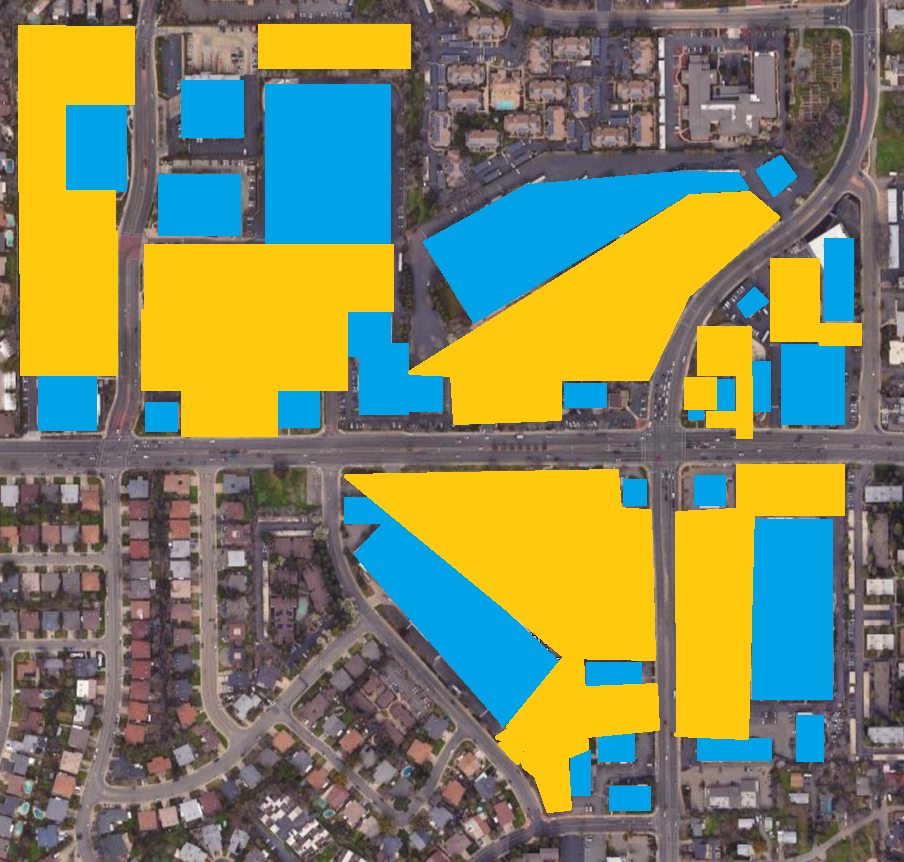
<p><img src="/assets/img/destination-parking-lots.png" alt="A top down satellite view of a suburban shopping center, yellow is parking and blue is buildings, more than half of the area is parking" /></p>

<p>I took a Google Maps satellite view of a shopping center close to where I live, I highlighted in blue the buildings and yellow the parking spaces, I left the areas behind the buildings where trucks load and unload merchandise. Over half of the area is used for parking. And this is a fairly good utilization ratio (percentage of total area dedicated to parking) shopping center, there are others with a worse ratio.</p>

<p>With more adoption of self driving cars the yellow area can shrink significantly, maybe to even a quarter of the current size. This is because a Robotaxi will drop-off a customer near the entrance of the store and drive away to pick-up other customers.  When the customer is done shopping they will order another car which will pick them up near the store entrance and drive them back home. The only time a car would need to park is if the customer drove a private car or the Robotaxi is using the parking space to wait for new pick-up requests.</p>

<h2 id="increased-use-of-mass-transit">Increased use of mass transit</h2>

<p>A potentially unrealized benefit of self driving cars would be increased mass-transit use. This will be a double-edged sword. Local transit options, such as bus networks and light-rail, will experience a significant drop in ridership. However, intercity transit services like Amtrak and Brightline will see an increase in passengers. This is because self driving cars will fix the <a href="https://en.wikipedia.org/wiki/Last_mile_(transportation)#:~:text=In%20transportation%20networks%2C%20%22last%20mile,station%20to%20their%20final%20destination">last mile problem of mass-transit</a>. In transportation networks, “last mile” describes the rising marginal cost of getting people from a transportation hub such as an airport or train station to their final destination. A train route may exist between city A and city B, but within city A it is inconvenient to reach the train station, leading to the rider driving to the train station in city A. And when arrived at city B the rider has no way to get to their final destination so they must rent a car or order an expensive tax/Uber, leading to more costs. It would have been simpler to drive yourself.</p>

<p>Self driving cars fix this by making it easy and low cost to take a self driving car to the train station, ride the train to city B, and take another self driving car to your final destination. No need to own a car or rent a car. Robotaxi operators won’t allow their cars to drive between metro areas, due to increased complexities and costs that involves, so users will be encouraged to take partner services like Amtrak, or Brightline, or Megabus, etc when leaving a metro area to another.</p>

<h4 id="large-hit-to-local-public-transit">Large hit to local public transit</h4>

<p>Local public transit like the bus and light-rail network will see a large drop in riders because a Robotaxi will be much more convenient and not that much more expensive. Local transit agencies could still adapt by switching to smaller, more frequent, and also autonomous busses. Or transit agencies could have high frequency expressway corridors like light-rail and Bus Rapid Transit on dedicated lanes in bottleneck areas that Robotaxi riders can use for more quicker commute. Or transit agencies could subsidize or run their own non-profit Robotaxi networks to serve underprivileged communities.</p>

<h2 id="increase-demand-for-walkable-neighborhoods">Increase demand for walkable neighborhoods</h2>

<p>All the arguments mentioned above would lead to an increase in walkable area demand. Now that people can have most of the conveniences of a car without any of the drawbacks of car ownership, and there are Fewer cars on the road, and there is less car-centric parking developments, we will witness a massive growth in walkable city lifestyles. People would be able to live in dense areas and simple order a Robotaxi if they need to go further than walking distance. This is possible now but Taxis and Uber with a human driver is too expensive so only a tiny few can afford to live like this. With Robotaxis most people will be able to live like this. Increasing everyone’s freedom and quality of life.</p>

<h2 id="summary">Summary</h2>

<p>In summary, the widespread adoption of autonomous vehicles will significantly impact urban living and improve overall quality of life. As riding autonomous vehicles becomes cheaper than owning a car, fewer vehicles will be on the road, leading to less need for private parking and driveways. This will foster more densely packed housing developments with shared spaces and narrower streets. Additionally, the reduction in destination parking will free up urban land for other uses. While local transit options may see a decline, intercity transit will likely benefit as self-driving cars solve the last-mile problem. Ultimately, these changes will drive a demand for more walkable neighborhoods, enhancing community integration and increasing freedom for all.</p>

<h2 id="qa">Q&amp;A</h2>

<p>Here are some potential questions or arguments that I thought of. This section will be published empty or with little content and expand over time. If you wish to contact me please do so in my contact information in the footer.</p>

<p><strong>Argument: Most people will want to own a car</strong></p>

<p><strong>Response:</strong> Even a modest decrease in car ownership, say a 25% decrease, will have a big impact on our urban environment. Plus, I do not believe most people want to own a car, most people simply want to travel by car and doing so without owning a car now (hire a Taxi/Uber) is too cost prohibitive.</p>

<div class="footnotes" role="doc-endnotes">
  <ol>
    <li id="fn:1" role="doc-endnote">
      <p>This assumes the car owned does not have its own built-in self driving technology/system that you can enable at any moment. <a href="#fnref:1" class="reversefootnote" role="doc-backlink">&#8617;</a></p>
    </li>
  </ol>
</div>]]></content><author><name></name></author><category term="technology" /><category term="urbanism" /><category term="autonomous-vehicles" /><summary type="html"><![CDATA[&lt;!– Research Links and Notes]]></summary></entry><entry><title type="html">Right to repair is more than repair</title><link href="/2021/07/21/right-to-repair.html" rel="alternate" type="text/html" title="Right to repair is more than repair" /><published>2021-07-21T07:00:00+00:00</published><updated>2021-07-21T07:00:00+00:00</updated><id>/2021/07/21/right-to-repair</id><content type="html" xml:base="/2021/07/21/right-to-repair.html"><![CDATA[<p>The  <a href="https://www.ifixit.com/Right-to-Repair/Intro">Right to Repair</a>  movement has reached the mainstream, and is making political progress in  <a href="https://uspirg.org/blogs/blog/usp/half-us-states-looking-give-americans-right-repair">half the States</a>  in the United State and President Joe Biden including it in a massive  <a href="https://www.theverge.com/2021/7/9/22569869/biden-executive-order-right-to-repair-isps-net-neutrality">Executive Order</a>. This is all great news and is a sign of a shift in culture, a positive shift. There are many positives to a culture that promotes Right to Repair:</p>

<ul>
  <li>Better for the environment and sustainability.</li>
  <li>Gives consumers and users more options when it comes to repairs. This helps with wait times for repairs and lowers prices for consumers</li>
  <li>Gives consumers more control over the products they own</li>
  <li>Helps create and sustain a circular / local economy</li>
  <li>Helps teach tinkering is  <a href="https://blogs.scientificamerican.com/observations/the-value-of-tinkering/">good for childhood development</a></li>
  <li><a href="https://www.nytimes.com/2021/07/14/technology/personaltech/right-to-repair-iphones-android.html">And much more (NYT paywall)</a></li>
</ul>

<p>However, it is important to not forget that culture is what is actually changing. Consumers are realizing that Right to Repair is not just for tinkerers and hackers, but can save them money. Consumers dug society into a hole of hard to repair devices and manufacturers like Apple  <a href="https://youtu.be/Npd_xDuNi9k?t=224">preventing component suppliers from selling to third party repair shops</a>  by buying these devices from manufacturers that didn’t respect the right to repair. Consumers got us here by choosing convenience and nice looking products over freedom and sustainability.</p>

<h3 id="the-decline-of-ownership">The decline of ownership</h3>

<p>While society is collectively crawling out of the repair hole, slowly, consumers are digging many other holes that I believe should be left untouched. The issue is a decline in ownership, in digital goods and even hardware. The Right to Repair fits into it, we as owners of devices should be able to choose by whom they are repaired, but it gets worse. Here are some examples of society abandoning ownership of convenience.</p>

<p><a href="https://www.pcmag.com/news/peloton-axes-free-just-run-feature-from-treadmill-bricking-it-for-non-subscribers"><strong>Peloton Axes Free ‘Just Run’ Feature From Treadmill, Bricking It for Non-Subscribers.</strong></a>  This sparked a massive backlash, yes, but the company has not undone its action yet. So now customers that bought a $3,000 “smart treadmill” cannot run on said treadmill unless they also pay a $39 a month service.</p>

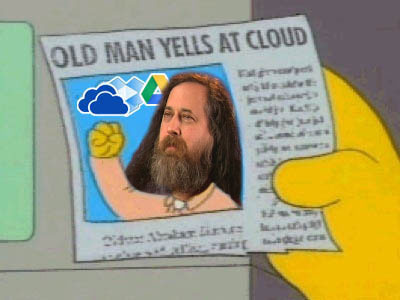
<p><strong>Everything is becoming a subscription</strong>. Netflix, Spotify, Disney+, Microsoft Game Pass, UPlay+, PlayStation Plus, etc. People don’t even rent content anymore, people rent access to services that may have the content they want. It is extremely convenient yes, and I have a few on that list, but it is a worrying future. So much control is given over to these companies in order for them to provide us convenience, do we really need it all?</p>

<p><img src="/assets/img/stallman_screams_at_cloud.jpg" alt="Richard Stallman screams at clouds meme" /></p>

<p><strong>Rise of Cloud Computing</strong></p>

<p>With rapid growth of  <a href="https://aws.amazon.com/">Amazon’s AWS</a>  services and <a href="https://cloud.google.com/">Google Cloud Computing</a>  services and others it seems we don’t even need to own computers anymore. We already don’t need to install productive applications like Microsoft Word and Excel as they are found online,  <a href="https://www.office.com/">Microsoft Office 365 (Office online)</a>  for example, with a monthly subscription of course. Our photos and documents are conveniently stored on Dropbox and iCloud, accessible on any device, for a monthly fee of course. Microsoft is even considering an online Windows,  <a href="https://www.microsoft.com/en-us/windows-365">Windows 365</a>  where you can “Securely stream  your  Windows experience—including  your  personalized apps, content, and settings—from the Microsoft cloud to any device with  your  Windows 365 Cloud PC.”</p>

<p>But when Microsoft said “your” in that sentence they forgot to mention, its not actually yours. Cloud Computing isn’t anything magical, its just someone else’s computer. We are now choosing to abandon our computers and lease someone else’s computers, for convenience…and a monthly subscription.</p>

<p><strong>We do not own our digital content anymore</strong>. Even when we “buy” digital content like video games on Steam and movies on Google Play Store we still don’t actually own them. For example from this Los Angles Times article:  <a href="https://www.latimes.com/business/lazarus/la-fi-lazarus-digital-content-20160513-snap-story.html">Column: When you buy digital content on Amazon or iTunes, you don’t exactly own it</a> it talks about the iTunes store how</p>

<blockquote>
  <p>“Apple and its licensors reserve the right to change, suspend, remove or disable access to any iTunes products, content or other materials comprising a part of the iTunes service at any time without notice.”</p>
</blockquote>

<p>This isn’t ownership. We merely have the privilege to read the eBooks and watch the shows the companies allow us at this time. Of course we cannot choose how to consume the content we just paid for, often times you need access to the internet to consume the content we bought. In my opinion your didn’t really purchase any digital content until you get a  <a href="https://www.techopedia.com/definition/24882/drm-free">DRM-free</a>  version of that content.</p>

<p><strong>Tesla disabled supercharging and software updates for a car after he repairs it himself</strong>. Video from YouTube channel @Rich Rebuilds found  <a href="https://youtu.be/okLgtYgnd7A">here</a>. This one is an example of Right to Repair issues leaking into the industry where independent repairs are expected, automobile industry, not only is Tesla saying you should not repair your own car but they actively punish someone for doing so.</p>

<h3 id="conclusion">Conclusion</h3>

<p>I believe that these are all really negative developments in our culture. We are letting these companies get away with taking away our freedoms to own what we purchased. Collectively we should resist and fight back against such practices. Right to Repair is more than just fixing smartphones, its a cultural movement that covers digital content and computing too. The fight is never over.</p>]]></content><author><name></name></author><category term="technology" /><category term="right-to-repair" /><category term="innovation" /><summary type="html"><![CDATA[The Right to Repair movement has reached the mainstream, and is making political progress in half the States in the United State and President Joe Biden including it in a massive Executive Order. This is all great news and is a sign of a shift in culture, a positive shift. There are many positives to a culture that promotes Right to Repair:]]></summary></entry><entry><title type="html">Cryptocurrencies are simply dumb, when will the modern Tulip mania end?</title><link href="/2020/10/26/crypto-currencies-are-dumb.html" rel="alternate" type="text/html" title="Cryptocurrencies are simply dumb, when will the modern Tulip mania end?" /><published>2020-10-26T07:00:00+00:00</published><updated>2020-10-26T07:00:00+00:00</updated><id>/2020/10/26/crypto-currencies-are-dumb</id><content type="html" xml:base="/2020/10/26/crypto-currencies-are-dumb.html"><![CDATA[<p>Ever since Bitcoin, a Cryptocurrency, was invented by Satoshi Nakamoto in 2009 we have seen massive, near cult-like, support online for the technology, and in the last few years a flood of speculative capital for Bitcoin and the thousands of other Cryptocurrencies. After looking at the claims (given by the community or Coin founders) I came to the conclusion that all decentralized cryptocurrencies are going to always be a very inefficient way for speculators to speculate and for a niche community to stay alive.</p>

<h2 id="disrupt-the-financial-sector-when-and-how">Disrupt the financial sector? When? And how?</h2>

<p>It seems everyone and their mother has some revolutionary technology or idea that will disrupt something. So far, nothing has been disrupted nor are we getting closer to disrupting anything. Here are the claims cryptocurrency proponents say about the superiority of cryptocurrencies compared to fiat currencies like the US Dollar.</p>

<p>The first set of claims I will debunk are found here:
<a href="https://www.visualcapitalist.com/cryptocurrency-redefining-future-of-finance/">Cryptocurrency: Redefining the Future of Finance</a></p>

<h4 id="privacy">PRIVACY:</h4>

<blockquote>
  <p>Anonymized transactions protect users data through cryptographic techniques</p>
</blockquote>

<p>Cryptocurrencies are sold as a great way to avoid spying by governments, to keep our financial life our own. However, this isn’t even true because at best it makes its users pseudonymous, meaning you can eventually be linked back to your real-world identity if you use the currencies in the general economy. Because all wallets in Bitcoin, the most popular cryptocurrency, is linked to transactions, you can simply walk them backwards to eventually find a link to a name or address. Example on how the government can still spy on you:</p>

<ol>
  <li>You live in a Utopia where everyone accepts and uses Bitcoin</li>
  <li>Your employer send you 1 Bitcoin a month <strong>A -&gt; B</strong></li>
  <li>You send 0.5 Bitcoin to your Mortgage company <strong>B -&gt; C</strong></li>
  <li>You send your friend 0.01 Bitcoin for drinks <strong>B -&gt; D</strong></li>
</ol>

<p>Now on the surface, the government does not know who is wallet B, or wallet D, but they will know that wallet C is a mortgage company, and that wallet A is a registered company. They will simply force either entity, with say a search warrant, to tell them who wallet B belongs to (your employers know your address and name, so does your bank). And now the government can see exactly where you send money, and where it comes from, forever, as now they can see all your future transactions linked to your wallet.  A much better privacy tool already exists, cash.</p>

<h4 id="access">ACCESS</h4>

<blockquote>
  <p>Providing a new financial model for <strong>1.7B</strong> unbanked individuals around the world</p>
</blockquote>

<p>This is an absurd claim. If someone, usually in the third-world, does not have a bank account there is a 99.99% chance they will also not have internet access. So digital currencies will do nothing for them.</p>

<h4 id="efficiency"><strong>EFFICIENCY</strong></h4>

<blockquote>
  <p>Steep reductions in settlement time and efficacy could save consumers <strong>$16 billion</strong> annually</p>
</blockquote>

<p>They did not provide sources for such a claim, nor is an impressive reduction, compared to the $4.4 Trillion in digital transactions we had in 2020 [<a href="https://www.statista.com/outlook/296/100/digital-payments/worldwide">source</a>] that makes up a 0.36% savings. A rounding error, not a disruption.</p>

<p>Further, let’s not talk about how Bitcoin alone consumes 70 TWh of electricity year (that is enough electricity to charge 1.4 Billion Tesla Models 3s) to process 1.4 million transactions a year. [<a href="https://digiconomist.net/bitcoin-energy-consumption/">source</a>]. Compared to Visa handling  150 Million transactions a day [<a href="https://usa.visa.com/run-your-business/small-business-tools/retail.html">source</a>] and uses a tiny fraction of the electricity.</p>

<p>Bitcoin is so inefficient I say it should be outlawed just for being such a waste of electricity.</p>

<h4 id="security"><strong>SECURITY</strong></h4>

<blockquote>
  <p>Providing immutable, traceable records of security-rich transactional networks</p>
</blockquote>

<p>The system itself is secure, as you cannot manipulate the blockchain (in practice), but that does not mean the users should feel safe. Bitcoin’s real issue when it comes to security is that it is not managed by a central authority. This means if someone steals your Wallet (<a href="https://cointelegraph.com/bitcoin-for-beginners/what-is-bitcoin-wallets">simply a private key</a>) you lost all your money. In traditional banks, transactions can be reversed if fraud is involved, not for Cryptocurrencies. To 99% of the userbase that is less safe.</p>

<h4 id="programmable-money"><strong>PROGRAMMABLE MONEY</strong></h4>

<blockquote>
  <p>Smart contracts could drastically eliminate manual and administrative work⁠— ultimately bypassing them altogether</p>
</blockquote>

<p>I will cover smart contracts in a later article. But basically, it’s over promise and under deliver on a grand scale.</p>

<h3 id="fundamental-issues-with-cryptocurrencies">Fundamental issues with cryptocurrencies</h3>

<h4 id="cannot-replace-fiat-currencies">CANNOT REPLACE FIAT CURRENCIES</h4>

<p>Despite what Libertarians might claim, Bitcoin or any other decentralized cryptocurrency will not  <a href="https://www.urbandictionary.com/define.php?term=End%20the%20Fed">End The Fed</a>. Though the government cannot technically censor any cryptocurrency protocol, it can make it practically unusable by making trade of it to real currency extremely difficult. Shutting down all exchanges (including not allowing banks to deal with foreign exchanges) and outlawing retailers from accepting it means the only way to acquire cryptocurrencies will be through sketchy illegal means that the vast majority of the population will never consider.</p>

<p>Plus, why would anyone consider it? If they get paid in the national currency (by law) and they must pay taxes in the national currency than why would anyone accept cryptocurrencies just to eventually trade them (in a sketchy way) to the national currency? Only criminals will go through the process of trading with cryptocurrencies.</p>

<h4 id="wont-help-anyone-in-venezuela">WON’T HELP ANYONE IN VENEZUELA</h4>

<p>Proponents often show how terrible Hyperinflation is in Venezuela, a stable currency for someone in Venezuela is very important. To that, I say yes, but cryptocurrencies won’t help them. First, if they don’t have any cryptocurrencies already buying them with Venezuela currency is extremely difficult and expensive as nobody will trade anything for Venezuela currency. Second, if the argument is that if they got the Cryptocurrencies before the national currency collapses than I say this could be applied to anything; if they bought dollars before the national currency collapse they will also be well off, actually, with dollars they will be better off as they are acceptable by anyone in the world. Hindsight is something everyone has.</p>

<h4 id="limited-supply-is-terrible-for-the-economy">LIMITED SUPPLY IS TERRIBLE FOR THE ECONOMY</h4>

<p>This is related to my previous argument, Cryptocurrency proponents claim that because the supply is limited, for example, Bitcoin cannot exceed 21 million bitcoins (this includes any Bitcoins from lost wallets), therefore inflation is impossible.</p>

<p>Though it is true that inflation is impossible, the effect on the economy is that the economic engine will eventually come to a standstill. This is because as we start to approach the ceiling the Miners (entities that process transactions on the Bitcoin blockchain) get less and less Bitcoin reward for their work, the total supply of Bitcoin will be a Logarithmic function that approaches but never reaches 21 million, while the Miner reward approaches but never reaches zero. All this means is that eventually, not even that far away, practically no new Bitcoins will be created and the only reward left for Miners is fees. Over time, transaction fees will go up, choking the economy and making micro-transactions extremely impractical (one of the benefits of cryptocurrencies).</p>

<p>On top of that, the modern meme of the 1% “sitting” on piles of money will actually be real now. Because unlike in Fiat currency, where the economy pie is always growing, a cryptocurrency economy is a zero-sum game, you having a Bitcoin means I don’t have it. Social unrest will be much worse.</p>

<h4 id="simplified-international-transactions-you-say">SIMPLIFIED INTERNATIONAL TRANSACTIONS YOU SAY?</h4>

<p>All transactional benefits cryptocurrencies offer rely on one prerequisite: everyone uses the same cryptocurrency and that cryptocurrency is accepted everywhere. Without that requirement all benefits are meaningless.</p>

<p>Here is the best-case scenario for sending cryptocurrencies internationally (if you already have the exact type of cryptocurrency that you need and it’s widely used in the nation you are sending to:</p>

<ol>
  <li>Send cryptocurrency  <strong>[pay fee for transaction]</strong></li>
  <li>The receiver uses cryptocurrency to purchase goods or services</li>
</ol>

<p>However, this is extremely unlikely. Instead, here is the real process:</p>

<ol>
  <li>Convert your national currency into cryptocurrency  <strong>[pay a fee for the conversation]</strong></li>
  <li>Send cryptocurrency  <strong>[pay fee for transaction]</strong></li>
  <li>Receiver converts cryptocurrency into national currency  <strong>[pay a fee for the conversation]</strong> assuming robust exchanges exist</li>
  <li>Receiver uses national currency to purchase goods or services</li>
</ol>

<p>This also assumes the receiver is</p>
<ul>
  <li>has an internet connection</li>
  <li>is tech-savvy enough understand WTF a Bitcoin is, and</li>
  <li>hopefully nobody falls prey to the growing Crypto scams.</li>
</ul>

<p>Or people will simply use reputable and well-known services like TransferWise or MoneyGram.</p>

<p>And if we finally get the Lizard People Illuminati controlled One World Government that Alex Jones is afraid of, then international money transfer will be as simple and instant as using Zelle inside the United States. I am hoping the World Government comes sooner than later. And a single world fiat currency.</p>

<h4 id="more-than-one-cryptocurrency-exists-you-say">MORE THAN ONE CRYPTOCURRENCY EXISTS YOU SAY?</h4>

<p>Unless one of the cryptocurrencies becomes an overwhelming majority in terms of transaction volume the fragmentation within the sphere means none of them can succeed.</p>

<p>How can an economy function well if people are paid with one currency, pay rent with a second currency, buy groceries with a third, and pay for Netflix with a fourth? The amount of friction and fees to convert between them is going to be ridiculously expensive.</p>

<p>There are thousands of cryptocurrencies out there, meaning 99.9% of them must die for the industry to have a chance to thrive. It’s a chicken and egg problem except this time there are thousands of chicken breeds that are incompatible with each other and are all trying to succeed.</p>]]></content><author><name></name></author><category term="technology" /><category term="bitcoin" /><category term="crypto" /><category term="controvertial" /><summary type="html"><![CDATA[Ever since Bitcoin, a Cryptocurrency, was invented by Satoshi Nakamoto in 2009 we have seen massive, near cult-like, support online for the technology, and in the last few years a flood of speculative capital for Bitcoin and the thousands of other Cryptocurrencies. After looking at the claims (given by the community or Coin founders) I came to the conclusion that all decentralized cryptocurrencies are going to always be a very inefficient way for speculators to speculate and for a niche community to stay alive.]]></summary></entry><entry><title type="html">Modern Feminism dropped the ball on mothers</title><link href="/2020/10/26/feminism-failed-women.html" rel="alternate" type="text/html" title="Modern Feminism dropped the ball on mothers" /><published>2020-10-26T07:00:00+00:00</published><updated>2020-10-26T07:00:00+00:00</updated><id>/2020/10/26/feminism-failed-women</id><content type="html" xml:base="/2020/10/26/feminism-failed-women.html"><![CDATA[<p>Two events happened in a short period of time that got me thinking about the feminist movement and the lost opportunity for social change that resulted in it. First, my girlfriend (a recent immigrant to the US) asked if there are any government programs that pay stay-at-home mothers for their real and measurable labor of raising children. I found that question amusing because trying to pass legislation like that in 2020, with Republicans controlling the Senate and the Presidency would be practically impossible, but it did get me thinking. That idea sounds great and why it’s not pushed for is strange.</p>

<p>The other event was me listening to a Joe Rogan Experience podcast episode with Douglas Murry and Douglas mentioned the issue that the feminism movement has dealing with the question of motherhood vs career. Here is a link to the full episode on Spotify, skip to around 116:00 to get to the specific discussion.</p>

<p><a href="https://open.spotify.com/episode/3z58RgmzyxqqNjrUdA0pA9?si=qOKHYysITPuViuwBMonnLQ">Spotify: #1538 – Douglas Murray</a></p>

<p><img src="/assets/img/generic-office-meeting-1.jpg" alt="men and women in a meeting" /></p>

<p>“Feminism skipped motherhood” is an undoubtedly accurate statement. The movement that is meant to give women more rights and freedoms will struggle with this question, especially since modern feminism is about equity, not equality anymore. The view of modern feminism is to look at motherhood as a wasted opportunity, to look at it as money that could have been gained and careers that could have been pursued. That is a dark and dehumanizing view of the situation.</p>

<h4 id="money-is-the-goal-of-life">MONEY IS THE GOAL OF LIFE?</h4>

<p>When viewing motherhood as disempowering because it slows down career aspirations it implies that money is the only thing that matters. Which it certainly isn’t. It is disturbing and surprising that a social movement indirectly became a proponent of the Neo-Liberal idea that markets should be inserted into every facet of life. Capitalism is all that matters? I think not.</p>

<h4 id="trying-to-dismiss-womans-most-unique-ability">TRYING TO DISMISS WOMAN’S MOST UNIQUE ABILITY</h4>

<p>By trying to push women into the workforce and away from the home feminism is actually actively diminishing the most precious and unique ability of women: having children. Anyone can be a CEO of a company, man or woman, yet no man can bring life to this world. Instead of building on top of this fact, modern feminism tries really hard to completely ignore this gift. Every human being alive today came from a woman, every single one, that is incredible! Without women having children our entire species goes extinct, so what is more important, the CEO of some investment firm working to make more money for clients, or the woman that gave birth to that CEO? I say the latter. The most important asset we all have is our own lives and by dismissing the ability to make life feminists are really dropping the ball here.</p>

<p><img src="/assets/img/pregnant-1245703_1920.jpg" alt="woman holding pregnant belly" /></p>

<h4 id="putting-the-two-events-together">PUTTING THE TWO EVENTS TOGETHER</h4>

<p>Today feminists are spending a lot of resources, mental, financial, and social, to achieve what I consider diminishing returns of social progress. For example,  <a href="https://www.npr.org/2020/03/05/811192459/a-push-to-get-more-women-on-corporate-boards-gains-momentum">we think it’s very important to have specifically more women CEOs</a>  yet modern feminism spends very little energy on policies that help mothers. We know that <a href="https://www.theatlantic.com/health/archive/2020/01/how-much-does-it-cost-have-baby-us/604519/">childbirth is extremely expensive</a>  and that <a href="https://spendmenot.com/blog/how-much-does-it-cost-to-raise-a-child/">the cost of raising children is even higher</a>, where are the feminist outrages? We had a million women march on Washington after the election of Donald Trump, but no million women march to make it free to give birth? Why not? Women who choose to have a child should be not just encouraged but also empowered by feminism. Ignoring the most unique aspect of women by feminism could be the explanation as to why  <a href="https://www.pewresearch.org/fact-tank/2020/07/07/61-of-u-s-women-say-feminist-describes-them-well-many-see-feminism-as-empowering-polarizing/">a majority of women don’t identify as feminists.</a></p>

<h4 id="conclusion">CONCLUSION</h4>

<p>It will be a massive social undertaking, but the feminist movement needs to focus on policies that actually help all women not just those that want to have a career. The best way to achieve this is to push for Universal Healthcare that covers giving birth and programs to give women, or men, that stay at home and raise children an income so they actually have the choice to do what they truly want, not just what the market needs right now.</p>]]></content><author><name></name></author><category term="society" /><category term="feminism" /><category term="motherhood" /><category term="modernity" /><category term="controvertial" /><summary type="html"><![CDATA[Two events happened in a short period of time that got me thinking about the feminist movement and the lost opportunity for social change that resulted in it. First, my girlfriend (a recent immigrant to the US) asked if there are any government programs that pay stay-at-home mothers for their real and measurable labor of raising children. I found that question amusing because trying to pass legislation like that in 2020, with Republicans controlling the Senate and the Presidency would be practically impossible, but it did get me thinking. That idea sounds great and why it’s not pushed for is strange.]]></summary></entry><entry><title type="html">Google can help Android, only if it shares</title><link href="/2020/06/25/google-can-help-android.html" rel="alternate" type="text/html" title="Google can help Android, only if it shares" /><published>2020-06-25T07:00:00+00:00</published><updated>2020-06-25T07:00:00+00:00</updated><id>/2020/06/25/google-can-help-android</id><content type="html" xml:base="/2020/06/25/google-can-help-android.html"><![CDATA[<p>Ad blockers have many great reasons to use them, including better security, better privacy, less or no advertisements to see, and as I wrote before on this blog,  <a href="https://www.weeklyinsightnews.com/2019/07/28/ad-blockers-will-greatly-boost-page-loads/">faster load times for web-pages.</a>  However there is a big downside to them, they might kill the free internet as we know it. And that is a good thing.</p>

<p>Websites and web services exist because someone is keeping the lights on, paying for the bandwidth, computing power, storage, and creating content. This should not be a surprise to most people as nothing in the world is free. Someone has to pay. Fortunately for us, there are many models websites can follow in receiving income:</p>

<ol>
  <li>Subscriptions ($$$)</li>
  <li>Donations (Free)</li>
  <li>Sponsorship (Free)</li>
  <li>Government funding (Free)</li>
  <li>Displaying advertisements (Free)</li>
  <li>Selling premium exclusive services (Free/$$)</li>
  <li>Company loss leader (Free)</li>
  <li>Gathering and selling user information (Free)</li>
  <li>Running crypto-currency mining operations on the user’s machine (Free)</li>
</ol>

<p>Let’s go through this list one by one to see how a website could use that model to keep operating. I will also explain if and how that model can break down in an age of mass adblocking usage. But before I do that I want to come out and say two things: I use adblockers daily and that I believe the usage of adblockers is immoral, which makes me an immoral and selfish person by my own standards. And I am not here to tell anyone to turn off their adblockers as I will not be doing so either, this is merely an educational thought experiment.</p>

<h3 id="why-i-believe-ad-block-usage-is-immoral">Why I believe ad-block usage is immoral</h3>

<p>I am not here to argue about the benefits of using ad-blockers, I know those benefits full well and written about the benefits. What I am here to talk about is the economics of widespread adblocker usage and the ethics of adblocker usage by a small percentage of people. The ethics boil down to a simple idea: ad-block users are being subsidized by those that use the website without ad-blockers. If the website receives most or all of its income from ad revenue and provides a service for free, like a video streaming site, then what is happening is users with ad-blockers get a better experience as they get the same free content without advertisements and the users without ad-blockers get a worse experience as they get the same content and must-see advertisements. And most importantly, the group that is getting the worse experience is subsiding the group that is receiving a better experience.</p>

<p>The closest physical example I can think of is fare jumping that is happening in the Bay Area Rapid Transit System (BART), where most users do pay their fare to get on the metro, but some jump the gate and come in for free. Both groups receive the same BART services, however, one of them is subsiding the group that gets more value by not paying at all.</p>

<p>It is easy to see why fare jumping is wrong but the same logic applies to ad-block usage. A simple rule of thumb to determine if an activity is right or wrong is to expand it to everyone. If everyone fare jumped BART would crumble due to no income and everyone suffers, similarly, as I will explain later if everyone blocks advertisements the revenue websites receive will go away and many websites will shut down. Once again, everyone suffers.</p>

<h2 id="subscriptions">Subscriptions</h2>

<p>The most simple and straightforward way to earn money is to charge your users a one-time fee or a regular fee to use the online service. We can see this with things like Netflix where users pay a fixed monthly rate to get access to Netflix’s complete library of Movies and TV Shows. We can also see this with many journalist publications like The Economist. This model of funding an operation existed long before the internet as the default way to make money off a service. This model is unaffected by ad-blocking. This model is also sustainable.</p>

<h2 id="donations">Donations</h2>

<p>When I said “kill the free internet as we know it,” that was more of a clickbait attention grabber. In an internet dominated by ad-blocking, there will still be free websites as multiple models support them without needing to have advertisements on your pages. Donations are a great example.</p>

<p>The donations model is as old as the subscription model, or even older. An example I can think of in the physical world is musicians and artists performing in public areas like streets and those passing by would donate if they enjoyed what they are seeing and/or are feeling generous. Online we all know about Wikipedia, the free encyclopedia, which stays afloat due to user donations. This model is unaffected by ad-blocking.</p>

<p>However, I do not think this model is as flexible or scalable as other models. Going back to Wikipedia for example, yes it is run by donations, but they do not produce much content. The content is mostly all written by and edited by the community, the majority of the cost (in theory at least) should be to pay the hosting and bandwidth of the site. Such a model will not work very well for sites and services with high costs and demand for lots of highly paid creative and smart content creators. YouTube, for example, has content coming from the community for free, however, their bandwidth costs are astronomical due to the sheer volume of videos they have. Based on a website called  <a href="https://everysecond.io/youtube">Youtube – Every Second</a>, the amount of new content uploaded is almost 10 hours of video every second. All of that gets processed and converted to dozens of formats and video sizes and stored permanently, so the cost to operate YouTube always grows. I do not believe it can be sustained with donations, it requires another model. The donations model is sustainable on small scales or with little overhead costs.</p>

<h2 id="sponsorship">Sponsorship</h2>

<p>There two are forms of sponsorship, one where the content is “sponsored” by another company in the form of a soundbite or favorable articles written. One example is a podcast I listen to often called the Joe Rogan Experience. At the beginning of each episode, Joe Rogan goes through this episode’s sponsors by talking about their products and talking about offer codes. I consider this to be more of an advertisement and is easily countered by ad-blockers by skipping to the content right after the sponsored segment or if there is a built-in mechanism to make sure the sponsored content is played the ad-blocker could overwrite the sponsored segment with something else.</p>

<p>For websites that post articles and blogs, they might have the entire article or blog to be sponsored, often written by the sponsoring company, where favorable elements are inserted about the sponsoring company with the style of the hosting site. This is called Native Advertising and it is a clever way to advertise and give the user something of value. There is no way to block Native Advertising as it is the actual content, however, it is not as scalable as I cannot envision YouTube staying free using this model as an income stream. It is sustainable on a small level though and can exist as a stable revenue source for blogs.</p>

<p>The second form of sponsorship is directly funding something just to have your name attached to it without goals of direct benefits. This is done for publicity stunts, like RedBull sponsoring <a href="https://www.youtube.com/watch?v=E9oKEJ1pXPw">a man jumping from space.</a>  By sponsoring some content or entire websites the content could stay free for all to enjoy and it is a way for companies to feel good about themselves and spread their brand recognition. Ad-blocking should not affect this revenue model.</p>

<p>This model, however, has two big downsides, the first is greater corporate control as they could cut sponsorship at any time leaving the website without income, and the second downside is that it is not scalable. It will take many large corporations dedicating massive sums of money to keep afloat a service like YouTube, so this model only works for small websites and onetime events or posts.</p>

<h2 id="government-funding">Government funding</h2>

<p>If there are Communists and Socialists reading right now they would perk up at the idea of government-controlled or funded internet, no more Capitalist greed online! However I do not have to spend much time talking about why the government should not fund most websites, this is self-evident. It can, however, continue the few programs it has right now like NPR and PBS, that content should be free to use and without advertisements.</p>

<h2 id="displaying-advertisements">Displaying advertisements</h2>

<p>The most widespread approach to funding online operations is showing advertisements on your website from services like Google AdSense and Microsoft Advertising. The approach is as simple as picking where on your webpage an advertisement will appear and services like Google AdSense will place an advertisement there depending on what user is viewing your site and if the user clicks the ad you made some money. Zero overhead is required on the side of the website owner as they have to do literally nothing for the ads to show up. This model is obviously going to go away with the widespread adoption of ad-block usage.</p>

<h2 id="a-better-post-free-internet">A better post free internet</h2>

<p>A future internet where mass ad-block usage permanently kills the idea of internet advertising will be a better and safer internet. The vast majority of free websites will stop existing, but that isn’t something bad. The vast majority of “free” websites are low-quality clickbait sites and articles with clickbait ads all over the webpage. In a post-advertising world, only quality content will exist.</p>

<p>To keep a website up without advertising you need to convince users to give you money either through donations or subscriptions, or some hybrid model of free and paid content. The only way users will give websites money is if they had quality content; articles like “most bought items at Walmart” where each item is an item and you must go to the next page will die fast, nobody will pay for that.</p>

<p>Another great benefit to a post advertising internet is more privacy. Companies like Google and Facebook exist for one purpose and one purpose only: to get as much information about you as possible, index it, and show you the advertisement that you are most likely to click. Google won’t go away because people will be willing to pay for its services like Google Search, YouTube, and Gmail. But Facebook will go away, nobody will pay to have access to Facebook.</p>]]></content><author><name></name></author><category term="technology" /><category term="Google" /><category term="Apple" /><category term="iOS" /><category term="Android" /><category term="smartphone" /><summary type="html"><![CDATA[Ad blockers have many great reasons to use them, including better security, better privacy, less or no advertisements to see, and as I wrote before on this blog, faster load times for web-pages. However there is a big downside to them, they might kill the free internet as we know it. And that is a good thing.]]></summary></entry><entry><title type="html">In defense of Xaviant and the subscription model</title><link href="/2020/06/25/in-defense-of-xaviant.html" rel="alternate" type="text/html" title="In defense of Xaviant and the subscription model" /><published>2020-06-25T07:00:00+00:00</published><updated>2020-06-25T07:00:00+00:00</updated><id>/2020/06/25/in-defense-of-xaviant</id><content type="html" xml:base="/2020/06/25/in-defense-of-xaviant.html"><![CDATA[<p>On May 12, 2020, Xaviant (a game development company), released a video announcing that a video game its players loved is coming back. Usually, this kind of video will get lots of love and upvotes on YouTube but instead, it is one of the most downvoted videos on YouTube.</p>

<p>It is very clear why this video got so much hate online: it is all because of this:</p>

<p><img src="/assets/img/xaviant-pricing-screenshot.png" alt="The Culling pricing structure" /></p>

<p>What just happened here is the game developer released a game but unlike the previous version of this game (which was pay once and play forever), this game appears to be a flat price plus you must pay a subscription to play online. People are upset and confused about having to pay to play a game they already paid for. I believe the anger is misguided and wrong, however, I also believe the game developer made the situation worse by having a complicated cost structure.</p>

<p>I never played this game, nor am I in the video game industry so I cannot speak from expert experience. However, I am a Software Engineer that can view what’s happening from a software lifecycle point of view. When looking at it from that point of view I can defend Xaviant on some level.</p>

<h4 id="one-time-income-long-term-expenses">ONE TIME INCOME, LONG TERM EXPENSES</h4>

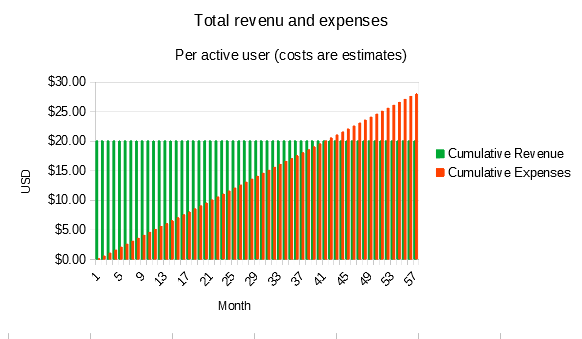
<p>The issue with online multiplayer games is that the company that operates them have regular expenses just to keep the multiplayer functionality running in playable performance. Running servers is NOT cheap, despite some common beliefs to the contrary. The long term financial view of a pay-once-play-forever multiplayer video game looks something like this, per active user. Note, my assumption was an average of $0.50 in expenses per month per active user, the exact figure is irrelevant as eventually, the cumulative revenue becomes less than cumulative expenses.</p>

<p><img src="/assets/img/revenue-vs-expenses.png" alt="Graph showing total expenses vs total revenue over time. The revenue stays flat and the expenses accumulate." /></p>

<p>Revenue stays flat, expenses add up. This is not sustainable.</p>

<h4 id="what-are-the-costs-of-running-a-game-like-the-culling">WHAT ARE THE COSTS OF RUNNING A GAME LIKE THE CULLING?</h4>

<p>Getting true expenses is difficult as some variables are fixed and others are dynamic, and others are somewhere in between. Some of the costs I can think of are:</p>

<ul>
  <li>Lease of office building plus utility costs (mostly a fixed monthly cost)</li>
  <li>Group of developers to maintain the game (mostly a fixed monthly cost)</li>
  <li>Group of non-developers to handle running the company, people like the CEO, HR, CFO, accountants, support representatives, etc. (mostly a fixed monthly cost)</li>
  <li>Servers to keep the game in existence, features like downloads, updates, matchmaking, friend system, online profile, etc. (mostly a fixed monthly cost)</li>
  <li>Servers to run the matches. (dynamic cost)</li>
</ul>

<p>I did not include taxes because those are included already in every expense listed.</p>

<h4 id="handling-the-problem">HANDLING THE PROBLEM</h4>

<p>Other games generally handled this problem by adding ways to have a constant revenue stream in their games. This could be something direct like a subscription for World Of Warcraft, or something indirect like cosmetic items to purchase with real currency, like in games like Fortnite, Counter-Strike Global Offensive, and Overwatch, this is also given the name of Loot Boxes. Or even it could be by releasing new games in a regular release cycle to generate a stream of revenue, for example, the Battlefield and Call of Duty series (though those two are firmly in the loot boxes space too). The last mechanism is something called Downloadable Content, where the developers add new features to the game but those new features must be bought.</p>

<p>Players don’t like Loot Boxes, nor do players like paying for DLCs. Xaviant wanted to try something new, pay as you play method, and give players all the future content but charge them to play online because that is a running cost. Unfortunately, the system they thought of is the least popular of them all.</p>

<h4 id="players-expectations-are-unsustainable">PLAYERS’ EXPECTATIONS ARE UNSUSTAINABLE</h4>

<p>In an ideal world, players want to get a game for free and play online for free while also getting all the updates and new content all for free. That is completely impossible unless some billionaire does it as a charitable donation to the society. If players cannot get the impossible they demand something unsustainable, pay for the game once (hopefully on sale), and expect the company to keep the servers running indefinitely. When confronted with a game where they pay for it once and continue to pay for it the players revolted. It was an overreaction to a bad launch of a game but its a sign of the future, all video games need a regular stream of income to stay alive. There is no way around it.</p>

<h4 id="a-better-price-structure-that-xaviant-should-have-went-for">A BETTER PRICE STRUCTURE THAT XAVIANT SHOULD HAVE WENT FOR</h4>

<p>Instead of a complicated web of prices, it should have been simpler.</p>

<p>$5.00 to buy the game. This will give you unlimited access to the Single Player and one free online match a day (if you quit a match within five minutes of it starting, excluding you being killed, then you can start another match for free the same day).</p>

<p>$5.00/month to get unlimited online matches.</p>

<p>You can play unlimited online matches within a team with your friends if at least one friend has a monthly subscription.</p>

<h4 id="conclusion">CONCLUSION</h4>

<p>Video games are changing. They are becoming harder and more expensive to make and at the same time, they are becoming harder and more expensive to keep running. As players, we must understand the lifecycle of a video game and also understand what a small company like Xaviant is really trying to do when they release an extremely unpopular pricing structure. They want to position the game to stay online for years. Not having money to keep servers running is not good for players.</p>]]></content><author><name></name></author><category term="technology" /><category term="buisness" /><category term="video-games" /><category term="controvertial" /><summary type="html"><![CDATA[On May 12, 2020, Xaviant (a game development company), released a video announcing that a video game its players loved is coming back. Usually, this kind of video will get lots of love and upvotes on YouTube but instead, it is one of the most downvoted videos on YouTube.]]></summary></entry><entry><title type="html">Ad blockers will kill the internet as we know it</title><link href="/2020/05/23/ad-blockers-kill-internet.html" rel="alternate" type="text/html" title="Ad blockers will kill the internet as we know it" /><published>2020-05-23T07:00:00+00:00</published><updated>2020-05-23T07:00:00+00:00</updated><id>/2020/05/23/ad-blockers-kill-internet</id><content type="html" xml:base="/2020/05/23/ad-blockers-kill-internet.html"><![CDATA[<p>Ad blockers have many great reasons to use them, including better security, better privacy, less or no advertisements to see, and as I wrote before on this blog,  <a href="/2019/07/28/adblocker-boos-load-times.html">faster load times for web-pages.</a>  However there is a big downside to them, they might kill the free internet as we know it. And that is a good thing.</p>

<p>Websites and web services exist because someone is keeping the lights on, paying for the bandwidth, computing power, storage, and creating content. This should not be a surprise to most people as nothing in the world is free. Someone has to pay. Fortunately for us, there are many models websites can follow in receiving income:</p>

<ol>
  <li>Subscriptions ($$$)</li>
  <li>Donations (Free)</li>
  <li>Sponsorship (Free)</li>
  <li>Government funding (Free)</li>
  <li>Displaying advertisements (Free)</li>
  <li>Selling premium exclusive services (Free/$$)</li>
  <li>Company loss leader (Free)</li>
  <li>Gathering and selling user information (Free)</li>
  <li>Running crypto-currency mining operations on the user’s machine (Free)</li>
</ol>

<p>Let’s go through this list one by one to see how a website could use that model to keep operating. I will also explain if and how that model can break down in an age of mass adblocking usage. But before I do that I want to come out and say two things: I use adblockers daily and that I believe the usage of adblockers is immoral, which makes me an immoral and selfish person by my own standards. And I am not here to tell anyone to turn off their adblockers as I will not be doing so either, this is merely an educational thought experiment.</p>

<h3 id="why-i-believe-ad-block-usage-is-immoral">Why I believe ad-block usage is immoral</h3>

<p>I am not here to argue about the benefits of using ad-blockers, I know those benefits full well and written about the benefits. What I am here to talk about is the economics of widespread adblocker usage and the ethics of adblocker usage by a small percentage of people. The ethics boil down to a simple idea: ad-block users are being subsidized by those that use the website without ad-blockers. If the website receives most or all of its income from ad revenue and provides a service for free, like a video streaming site, then what is happening is users with ad-blockers get a better experience as they get the same free content without advertisements and the users without ad-blockers get a worse experience as they get the same content and must-see advertisements. And most importantly, the group that is getting the worse experience is subsiding the group that is receiving a better experience.</p>

<p>The closest physical example I can think of is fare jumping that is happening in the Bay Area Rapid Transit System (BART), where most users do pay their fare to get on the metro, but some jump the gate and come in for free. Both groups receive the same BART services, however, one of them is subsiding the group that gets more value by not paying at all.</p>

<p>It is easy to see why fare jumping is wrong but the same logic applies to ad-block usage. A simple rule of thumb to determine if an activity is right or wrong is to expand it to everyone. If everyone fare jumped BART would crumble due to no income and everyone suffers, similarly, as I will explain later if everyone blocks advertisements the revenue websites receive will go away and many websites will shut down. Once again, everyone suffers.</p>

<h2 id="subscriptions">Subscriptions</h2>

<p>The most simple and straightforward way to earn money is to charge your users a one-time fee or a regular fee to use the online service. We can see this with things like Netflix where users pay a fixed monthly rate to get access to Netflix’s complete library of Movies and TV Shows. We can also see this with many journalist publications like The Economist. This model of funding an operation existed long before the internet as the default way to make money off a service. This model is unaffected by ad-blocking. This model is also sustainable.</p>

<h2 id="donations">Donations</h2>

<p>When I said “kill the free internet as we know it,” that was more of a clickbait attention grabber. In an internet dominated by ad-blocking, there will still be free websites as multiple models support them without needing to have advertisements on your pages. Donations are a great example.</p>

<p>The donations model is as old as the subscription model, or even older. An example I can think of in the physical world is musicians and artists performing in public areas like streets and those passing by would donate if they enjoyed what they are seeing and/or are feeling generous. Online we all know about Wikipedia, the free encyclopedia, which stays afloat due to user donations. This model is unaffected by ad-blocking.</p>

<p>However, I do not think this model is as flexible or scalable as other models. Going back to Wikipedia for example, yes it is run by donations, but they do not produce much content. The content is mostly all written by and edited by the community, the majority of the cost (in theory at least) should be to pay the hosting and bandwidth of the site. Such a model will not work very well for sites and services with high costs and demand for lots of highly paid creative and smart content creators. YouTube, for example, has content coming from the community for free, however, their bandwidth costs are astronomical due to the sheer volume of videos they have. Based on a website called  <a href="https://everysecond.io/youtube">Youtube – Every Second</a>, the amount of new content uploaded is almost 10 hours of video every second. All of that gets processed and converted to dozens of formats and video sizes and stored permanently, so the cost to operate YouTube always grows. I do not believe it can be sustained with donations, it requires another model. The donations model is sustainable on small scales or with little overhead costs.</p>

<h2 id="sponsorship">Sponsorship</h2>

<p>There two are forms of sponsorship, one where the content is “sponsored” by another company in the form of a soundbite or favorable articles written. One example is a podcast I listen to often called the Joe Rogan Experience. At the beginning of each episode, Joe Rogan goes through this episode’s sponsors by talking about their products and talking about offer codes. I consider this to be more of an advertisement and is easily countered by ad-blockers by skipping to the content right after the sponsored segment or if there is a built-in mechanism to make sure the sponsored content is played the ad-blocker could overwrite the sponsored segment with something else.</p>

<p>For websites that post articles and blogs, they might have the entire article or blog to be sponsored, often written by the sponsoring company, where favorable elements are inserted about the sponsoring company with the style of the hosting site. This is called Native Advertising and it is a clever way to advertise and give the user something of value. There is no way to block Native Advertising as it is the actual content, however, it is not as scalable as I cannot envision YouTube staying free using this model as an income stream. It is sustainable on a small level though and can exist as a stable revenue source for blogs.</p>

<p>The second form of sponsorship is directly funding something just to have your name attached to it without goals of direct benefits. This is done for publicity stunts, like RedBull sponsoring <a href="https://www.youtube.com/watch?v=E9oKEJ1pXPw">a man jumping from space.</a>  By sponsoring some content or entire websites the content could stay free for all to enjoy and it is a way for companies to feel good about themselves and spread their brand recognition. Ad-blocking should not affect this revenue model.</p>

<p>This model, however, has two big downsides, the first is greater corporate control as they could cut sponsorship at any time leaving the website without income, and the second downside is that it is not scalable. It will take many large corporations dedicating massive sums of money to keep afloat a service like YouTube, so this model only works for small websites and onetime events or posts.</p>

<h2 id="government-funding">Government funding</h2>

<p>If there are Communists and Socialists reading right now they would perk up at the idea of government-controlled or funded internet, no more Capitalist greed online! However I do not have to spend much time talking about why the government should not fund most websites, this is self-evident. It can, however, continue the few programs it has right now like NPR and PBS, that content should be free to use and without advertisements.</p>

<h2 id="displaying-advertisements">Displaying advertisements</h2>

<p>The most widespread approach to funding online operations is showing advertisements on your website from services like Google AdSense and Microsoft Advertising. The approach is as simple as picking where on your webpage an advertisement will appear and services like Google AdSense will place an advertisement there depending on what user is viewing your site and if the user clicks the ad you made some money. Zero overhead is required on the side of the website owner as they have to do literally nothing for the ads to show up. This model is obviously going to go away with the widespread adoption of ad-block usage.</p>

<h2 id="a-better-post-free-internet">A better post free internet</h2>

<p>A future internet where mass ad-block usage permanently kills the idea of internet advertising will be a better and safer internet. The vast majority of free websites will stop existing, but that isn’t something bad. The vast majority of “free” websites are low-quality clickbait sites and articles with clickbait ads all over the webpage. In a post-advertising world, only quality content will exist.</p>

<p>To keep a website up without advertising you need to convince users to give you money either through donations or subscriptions, or some hybrid model of free and paid content. The only way users will give websites money is if they had quality content; articles like “most bought items at Walmart” where each item is an item and you must go to the next page will die fast, nobody will pay for that.</p>

<p>Another great benefit to a post advertising internet is more privacy. Companies like Google and Facebook exist for one purpose and one purpose only: to get as much information about you as possible, index it, and show you the advertisement that you are most likely to click. Google won’t go away because people will be willing to pay for its services like Google Search, YouTube, and Gmail. But Facebook will go away, nobody will pay to have access to Facebook.</p>]]></content><author><name></name></author><category term="technology" /><category term="ad-blockers" /><category term="browsers" /><category term="internet" /><summary type="html"><![CDATA[Ad blockers have many great reasons to use them, including better security, better privacy, less or no advertisements to see, and as I wrote before on this blog, faster load times for web-pages. However there is a big downside to them, they might kill the free internet as we know it. And that is a good thing.]]></summary></entry><entry><title type="html">Personal Study: Ad blockers will greatly boost page loads</title><link href="/2019/07/28/adblocker-boos-load-times.html" rel="alternate" type="text/html" title="Personal Study: Ad blockers will greatly boost page loads" /><published>2019-07-28T07:00:00+00:00</published><updated>2019-07-28T07:00:00+00:00</updated><id>/2019/07/28/adblocker-boos-load-times</id><content type="html" xml:base="/2019/07/28/adblocker-boos-load-times.html"><![CDATA[<p>It will not be a surprise to most internet users that adblockers not only block ads and block malware (also known as <a href="https://www.malwarebytes.com/adware/">adware</a>) that may be inside the ads, but will also greatly boost page load times and cut down on bandwidth usage. In this hardly scientific personal study of mine I will go to a few technology news sites with and without an adblocker to determine how much time, bandwidth, and requests I save.</p>

<h4 id="my-setup">My setup:</h4>
<p>Windows 10 Home 64-bit
Google Chrome Version 75.0.3770.142 (Official Build) (64-bit)
Adblocker: https://getadblock.com/</p>

<h4 id="methodology">Methodology</h4>
<p>The tool I used to gather information is Google Chrome’s Developer Tools which gave me useful statistics like total HTTP requests made, DOM load time (the content of the site showed up), total load time (the loading spinner stopped spinning), when background threads stopped loading, bandwidth used over the wire, and total content loaded. To avoid getting content cached from previous loads I used Google Chrome’s “Empty Cache and Hard Reload” which shows up if the page is open with Developer Tools by clicking F12 and you right-click the reload icon. For me, the page is considered “loaded” when the loading spinner stops spinning for Google Chrome. For each website I performed the following steps:</p>

<ol>
  <li>Open Develop Tools on the current Tab,</li>
  <li>Disable my adblocker,</li>
  <li>Navigate to the webpage URL, do not wait for the page to load,</li>
  <li>Empty Cache and Hard Reload,</li>
  <li>Wait for the page to load,</li>
  <li>Screenshot the Developer Tools statistics,</li>
  <li>Enable the adblocker,</li>
  <li>Empty Cache and Hard Reload,</li>
  <li>Wait for the page to load,</li>
  <li>Screenshot the Developer Tools statistics.</li>
</ol>

<h2 id="engadgetcom">Engadget.com</h2>

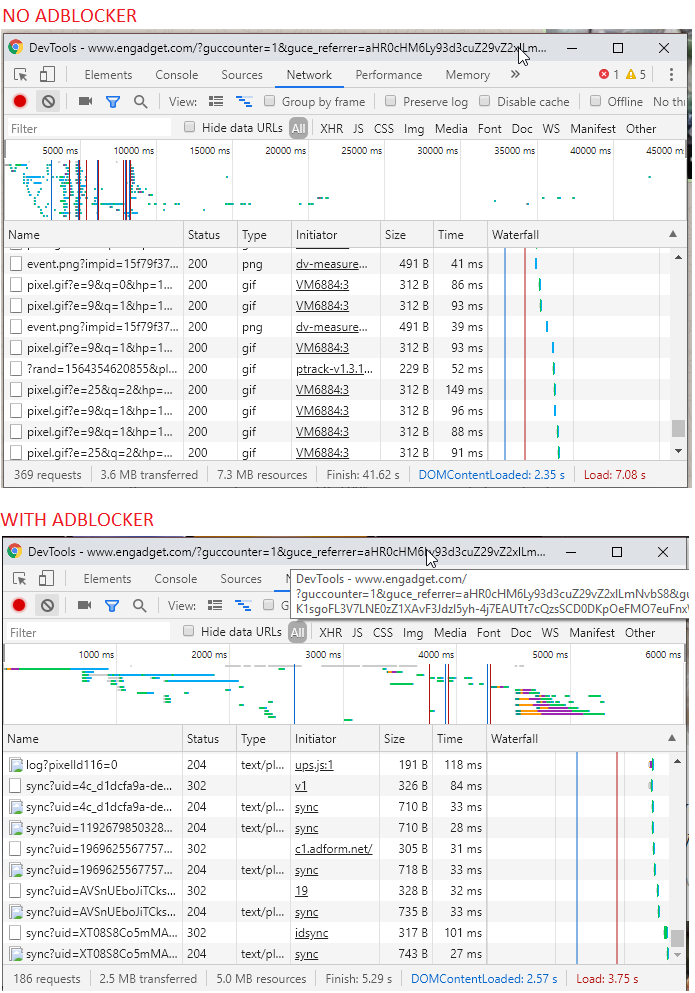
<p><img src="/assets/img/engadget.com_no_ad_blocker.png" alt="Engadget.com without ad-block and with ad-block" /></p>

<h3 id="results-for-engadgetcom">Results for Engadget.com:</h3>

<ul>
  <li><strong>Total Requests</strong>: we notice a sudden drop in total HTTP requests, almost a 50% reduction. This means fewer DNS lookups, less routing, and less home network congestion. <strong><font color="green">49.5% decrease</font></strong>.</li>
  <li><strong>Transferred</strong>: we notice a full Megabyte reduction of internet bandwidth usage, it may not seem much but we visit thousands of webpages a day so those Megabytes will add up. <strong><font color="green">30.5% decrease</font></strong>.</li>
  <li><strong>Resources</strong>: We noticed that the 1 MB of less bandwidth also correlated with fewer resources used (some content is compressed over transit and gets decompressed by your computer), using an adblocker means decreased RAM usage for this webpage. <strong><font color="green">31.5% decrease</font></strong>.</li>
  <li><strong>DOMContentLoaded</strong>: This shows when the HTML and CSS of the webpage got loaded and rendered, an ad blocker will not affect this figure. The slight variation between with adblocker and without adblocker I will attribute to decreased internet speeds at the moment of the page reload as I have wireless. <strong><font color="red">9.3% increase</font></strong>.</li>
  <li><strong>Load</strong>: This is the time after the page is fully loaded, or in my definition, the loading spinner stops spinning. After this time I consider a webpage is ready to be used. <strong><font color="green">47% decrease</font></strong>.</li>
  <li><strong>Finish</strong>: I mention this column last because it is the most interesting. This represents background nonblocking asynchronous objects and requests finishing. The website is completely usable while these are happening so this number can be ignored for most practical purposes. For Engadget.com this happened much longer after the page finished loading because, as you can see from the pixel.gif requests in the no adblocker picture, requests are being sent to data collectors about the user after the page is loaded. Everything from mouse movement to cursor position to window scrolling. I cannot confirm that is what Engadget.com is sending but that is my guess. Too much background requests lead to more HTTP requests made and more bandwidth usage. <strong><font color="green">87% decrease</font></strong>, and counting.</li>
</ul>

<h2 id="gizmodocom">gizmodo.com</h2>

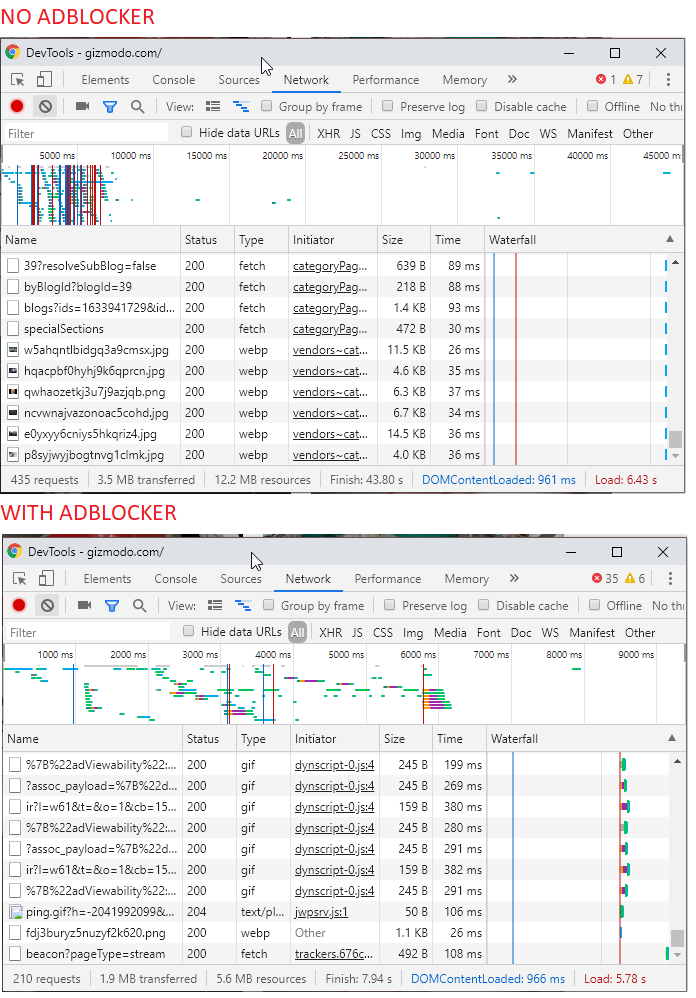
<p><img src="/assets/img/gizmodo.com_no_ad_blocker.png" alt="gizmodo.com without ad-block and with ad-block" /></p>

<p>Results for gizmodo.com:</p>

<ul>
  <li><strong>Total Requests</strong>: <font color="green">51.7% decrease</font>.</li>
  <li><strong>Transferred</strong>: <font color="green">45.7% decrease</font>.</li>
  <li><strong>Resources</strong>:  <font color="green">54% decrease</font>.</li>
  <li><strong>DOMContentLoaded</strong>: <font color="red">0.5% increase</font>.</li>
  <li><strong>Load</strong>:  <font color="green">10% decrease</font>.</li>
  <li><strong>Finish</strong>: <font color="green">82% decrease</font>, and counting.</li>
</ul>

<h2 id="slashdotorg">Slashdot.org</h2>

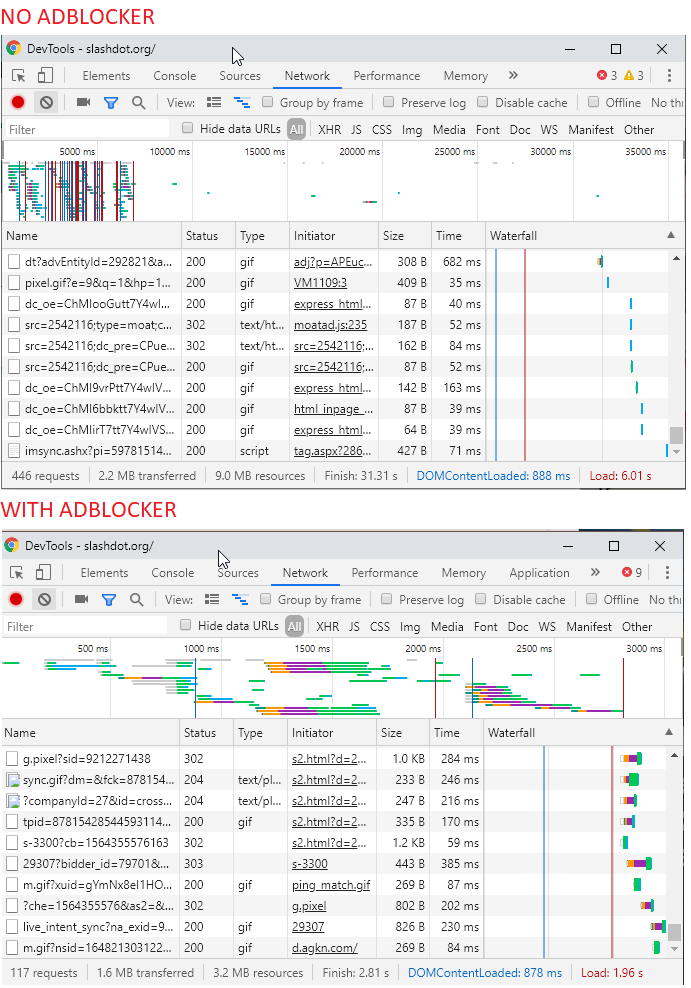
<p><img src="/assets/img/slashdot.org_no_ad_blocker.png" alt="slashdot.org without ad-block and with ad-block" /></p>

<p>Results for slashdot.org:</p>

<ul>
  <li><strong>Total Requests</strong>: <font color="green">73.7% decrease</font>.</li>
  <li><strong>Transferred</strong>: <font color="green">27.2% decrease</font>.</li>
  <li><strong>Resources</strong>:  <font color="green">64.4% decrease</font>.</li>
  <li><strong>DOMContentLoaded</strong>: <font color="green">1.1% decrease</font>.</li>
  <li><strong>Load</strong>: <font color="green">67.3% decrease</font>.</li>
  <li><strong>Finish</strong>: <font color="green">89.7% decrease</font>, and counting.</li>
</ul>

<h2 id="techcrunchcom">Techcrunch.com</h2>

<p><img src="/assets/img/techcrunch.com_no_ad_blocker.png" alt="techcrunch.com without ad-block and with ad-block" /></p>

<p>Results for TechCrunch.com:</p>

<ul>
  <li><strong>Total Requests</strong>: <font color="green">69.7% decrease</font>.</li>
  <li><strong>Transferred</strong>: <font color="green">30.3% decrease</font>.</li>
  <li><strong>Resources</strong>:  <font color="green">30.4% decrease</font>.</li>
  <li><strong>DOMContentLoaded</strong>: <font color="green">7.6% decrease</font>.</li>
  <li><strong>Load</strong>: <font color="green">90.5% decrease</font>.</li>
  <li><strong>Finish</strong>: <font color="green">92.9% decrease</font>, and counting.</li>
</ul>

<h2 id="conclusion">Conclusion</h2>
<p>It is clear that an adblocker will not only protect you from malware and hide annoying advertisements from your eyes, it will also make your webpages load faster and use less of your internet bandwidth. A win for everyone except the website owner.</p>]]></content><author><name></name></author><category term="technology" /><category term="ad-blockers" /><category term="browsers" /><category term="internet" /><summary type="html"><![CDATA[It will not be a surprise to most internet users that adblockers not only block ads and block malware (also known as adware) that may be inside the ads, but will also greatly boost page load times and cut down on bandwidth usage. In this hardly scientific personal study of mine I will go to a few technology news sites with and without an adblocker to determine how much time, bandwidth, and requests I save.]]></summary></entry><entry><title type="html">2019 Annual Tesla Shareholder Meeting thoughts</title><link href="/2019/07/01/annual-tesla-shareholder-meeting-2019.html" rel="alternate" type="text/html" title="2019 Annual Tesla Shareholder Meeting thoughts" /><published>2019-07-01T07:00:00+00:00</published><updated>2019-07-01T07:00:00+00:00</updated><id>/2019/07/01/annual-tesla-shareholder-meeting-2019</id><content type="html" xml:base="/2019/07/01/annual-tesla-shareholder-meeting-2019.html"><![CDATA[<p>On June 11, 2019, Tesla held their annual shareholder meeting for 2019 where CEO Elon Musk and his team outlined their progress and what they think of the future. If you missed the meeting you can watch it on YouTube, I will embed the video here:
<a href="https://www.youtube.com/watch?v=Va5i42D13cI" title="Tesla Annual Shareholders Meeting"><img src="https://img.youtube.com/vi/Va5i42D13cI/0.jpg" alt="Tesla Annual Shareholders Meeting" /></a></p>

<p>I will not discuss every point brought up, instead, I will talk about the most important long term issues and plans Tesla talked about. Those include insurance, self-driving, future battery raw material sourcing, and my personal thoughts about future battery improvements.</p>

<h3 id="insurance-and-vertical-integration-on-all-levels">Insurance and vertical integration on all levels</h3>

<p>During the shareholder meeting, Elon Musk mentioned being serious about Tesla starting their own insurance product for Tesla drivers. The benefit to consumers, as stated by Elon Musk, <a href="https://www.autonews.com/finance-insurance/how-tesla-plans-cut-customers-insurance-costs-tap-autopilot">is a lower premium</a> since Tesla has strong confidence in their Autopilot program, which leads to lower crashes and in turn makes the car safer and less costly to insure. Tesla believes they could undercut other insurance companies by offering Tesla drivers a lower premium while still making a profit off lower claim frequency.</p>

<p>On top of this Elon Musk mentioned in the meeting that Tesla is looking into doing bodywork repairs in-house which if true is another great reason to get into the insurance business; by owning the service centers, mobile service vehicles, charging stations (Superchargers), and bodywork on top of insurance means Tesla will have little leakage of money since revenue will come in from customers in the form of vehicle purchases, Supercharger use fees, and insurance premiums, and leave almost never as repairs could be done in-house meaning money will simply move from one Tesla operation to another Tesla operation. Paying for damage to other insurance companies and medical expenses in a crash is the exception of course.</p>

<p>There are issues however with Tesla joining the insurance business, the two biggest would be additional risk and liabilities, and the other being fighting an uphill battle. When it comes to the risk Tesla will need to realize that insurance is not a tech industry, it is simply having cash. Insurance companies are required, out of necessity and because of regulations, to maintain a certain level of cash reserves to cover the possible claims that could show up. This in practice means the cash strapped company will have even less cash as some must be set aside and not touched for other means. I do not believe Tesla is in the financial position to start an insurance company at the moment, they have too many other investments to put money into. Factory on every continent?  Supercharger  Megacharger expansion/buildout? More Gigafactories?</p>

<p>The other issue, fighting an uphill battle, is because Tesla the insurance company (assuming they will only cover Tesla drivers), is greatly limiting their pool of customers. An insurance company works by spreading out risk among many people: one crash and one hundred customers will be financially unsustainable, however, one crash and one thousand customers means its more manageable and now we could make a profit. And that is where Tesla will struggle. Traditional insurance companies have every possible driver to bid their product to, Tesla and non-Tesla drivers could get be the customers of traditional insurance companies. Tesla, on the other hand, can only offer their service to Tesla drivers (not all of whom will choose Tesla as their insurance company). Simply put, Tesla will have a smaller pool of customers to spread risk among.</p>

<p>Despite the risks and difficulties, I believe that if Tesla could get this done they will have a really strong revenue stream and lower costs by vertically integrating three types of business: car manufacturing, insurance, and maintenance and repairs.</p>

<h3 id="self-driving-future">Self Driving future</h3>

<p>During 2019 Tesla Autonomy Day (video below) Tesla showed off how their cars could drive without human input on highways and streets. The short clip included the car driving without human input on residential streets, main streets, and the highway. It handled lane changes, stop signs, traffic signal lights, and merging and exiting the highway. On top of all that, it slowed down and sped up based on traffic in front of it. The self-driving features of Tesla cars are one of the big moats that the company has against other electric cars and all car manufacturers in general. I will talk about the other moats in a later blog post.</p>

<p>In the next decade or two not having a car that can drive for you is like having a car today without Bluetooth or AUX connectivity or a backup camera, it will feel old and obsolete. And unlike Bluetooth, AUX, and a backup camera, which can be added for under $100, a car without self-driving capabilities will always not have self-driving capabilities because adding them would be too expensive. Would make more sense to simply buy another car.</p>

<p><a href="https://www.youtube.com/watch?v=Ucp0TTmvqOE" title="Tesla Autonomy Day"><img src="https://img.youtube.com/vi/Ucp0TTmvqOE/0.jpg" alt="Tesla Autonomy Day" /></a></p>

<h3 id="mining">Mining?</h3>

<p>Elon Musk left a small comment saying that Tesla might get into some small scale mining in the future if the supply of rare-earth materials to make batteries could get threatened. This to me makes sense knowing that Tesla built the Gigafactory to handle the poor supply of batteries. During the Shareholder meeting, Elon Musk said that the reason for making the Gigafactory was to meet their own battery demands; no supplier of batteries could meet the ambitious demands of Tesla. We can see that now with the Gigafactory producing  <a href="https://thedriven.io/2018/11/05/tesla-and-panasonic-produce-60-of-global-ev-batteries/">more than half of the world’s EV batteries</a>. This is great but as Tesla continues to ramp up production of batteries and cars they might face another issue,  <a href="https://www.reuters.com/article/us-usa-lithium-electric-tesla-exclusive/exclusive-tesla-expects-global-shortage-of-electric-vehicle-battery-minerals-sources-idUSKCN1S81QS">supply shortage of minerals needed to make the batteries</a>. Knowing this potential threat to the business in the future it makes sense for Tesla to begin looking into acquiring or partnering with mining companies to make sure the supply never ends.</p>

<h3 id="batteries">Batteries?</h3>

<p>Without good and always improving batteries Tesla would have never succeeded. The quality of the battery makes or breaks an electric car: the batteries need to be energy dense, have a long life span, be able to charge quickly and produce consistent high amounts of power on demand to the motor. Tesla custom made batteries check every box and then some but being the best now is not good enough, you have to be the best tomorrow, next year, and in ten years. Tesla did not bring up batteries this meeting, unless I missed it, and would in an upcoming  <a href="https://www.teslarati.com/tesla-battery-and-drivetrain-investor-day-date-elon-musk/">Battery and Drivetrain Day in Q3 2019</a> where I Tesla might speak about their plans for Maxwell Technologies after its  <a href="https://electrek.co/2019/06/12/tesla-battery-cell-production-maxwell-tech/">acquisition of Maxwell Technologies</a>. The current partnership with Panasonic at the Gigafactory is great but it still means Tesla is reliant on other companies to do what it could do by itself, purchasing a battery manufacturer should help Tesla more closely vertically integrate its business.</p>

<p>I also expect news of better batteries, currently, the Model S and X have an  <a href="https://www.tesla.com/support/vehicle-warranty">eight-year infinite mile warranty on the batteries and drivetrain</a>. And I suspect that the biggest reason this warranty cannot be bumped up more is that the batteries deteriorate faster than the motor: Elon Musk says Tesla is  <a href="https://electrek.co/2019/04/23/tesla-battery-million-miles-elon-musk/">working on a 1,000,000 mile motor</a>. If Tesla could make their batteries last one million miles it will be a game changer for the resale value of Tesla cars. Currently, internal combustion cars after 100,000 miles are considered really bad because that is when all the mechanical problems start to kick in: needing to change belts, spark plugs, putting in long-lasting fluids, checking your engine and transmission for wear and tear, etc. A car with very little moving parts does not need to worry about any of this; a Tesla with a rated million-mile battery and motor can be sold second hand at 200K, 300K, even 500K miles, and the buying really must worry about the visuals and tires: are the seats torn up, are the tires worn out, is the pain scratched, etc. This shift in mindset is what will propel people to buy electric cars and keep them long term.</p>]]></content><author><name></name></author><category term="technology" /><category term="investing" /><category term="tesla" /><category term="cars" /><category term="autonomy" /><summary type="html"><![CDATA[On June 11, 2019, Tesla held their annual shareholder meeting for 2019 where CEO Elon Musk and his team outlined their progress and what they think of the future. If you missed the meeting you can watch it on YouTube, I will embed the video here:]]></summary></entry></feed>